Tuesday, 3 February 2015

Frequently Asked Questions About Body Image And Beauty

What is meant by the term "body image"?

Body image is the term used to describe how we see ourselves when we look in the mirror - and how we believe others see us. Different than a reflection, which is what the mirror "sees," body image encompasses the state of mind in which we view that reflection. For example, a stranger may look at you and see an attractive, well-groomed person. But you may see yourself as overweight, unattractive, or even ugly and believe that others see you that way as well. Part of what we see in the mirror relates to where we have trained our eyes to look first - usually our perceived flaws. The rest of what we see is filtered through our mind’s eye - the image we see reflects back the image we have of ourselves in our head a picture which may or may not accurately represent the true reflection in the mirror.

What do the terms "negative" and "positive" mean in relation to body image?

A "negative" body image is characterised by a distorted perception of how we really look. For example, you may see your breasts as being too small or your legs as being too short when in reality they are both of average size. People with a negative body image usually view themselves as unattractive, think that others in their life are more attractive (like a sibling or parent) and believe that their unattractive appearance is somehow a reflection of who they are inside. A "positive" body image exists when the reflection we see is an accurate one. It doesn’t mean we don’t see our flaws. It just means we are realistic about them, and we can also see our attributes. Having a positive body image means celebrating and appreciating your physical appearance, and loving what you see, warts and all!

How can I have a good body image when society’s view of my size is so negative?

It’s true that we are continuously bombarded with images of the "perfect" body and that can make us feel insecure. For those with an already negative self-image, these "ideals" can further reinforce bad feelings. The way to counter that pressure, say experts, is to first realise that only a chosen few actually "measure up" to society’s unrealistic standards - and they frequently do so at a cost to their health. Moreover, realise that your personal body image is reflected best by who you are, not how you look compared to someone else.

Is it possible for a woman to have a satisfying sex life if she has a terrible body image?

Interestingly, research shows that sometimes sexual dysfunction in women frequently characterised by a lack of desire is really all about not feeling desirable. In a study published in the Journal of Sex Research doctors found that women who felt less attractive than they did 10 years before reported a decrease in sexual desire. Women who reported feeling as attractive as they did in the previous decade reported more satisfaction with their current sex life. While the study doesn’t prove that feeling attractive boosts a woman’s sex drive, it does suggest the two go hand-in-hand.

What are the links between eating disorders and body image?

Women with a negative body image are at greater risk of developing an eating disorder, and women with an eating disorder frequently have a negative and often unrealistic body image. Moreover, women with a poor body image often try to use weight loss to boost their self-esteem, only to find it doesn’t work. In fact, most women with eating disorders continue to have a negative body image, often viewing themselves as overweight, even after they become painfully thin.

I’ve always dreamed of being that perfect size 8, but my body wants to stay forever size 16. Is there a trick to learning to love the skin I’m in even if I’ll never be that size 8?

The answer is yes and experts say it begins with accepting the idea that "big" is not "bad." What counts most is the state of your health - factors such as blood pressurecholesterol, blood sugar, body mass index, and your level of fitness. If your doctor says you check out OK, then you can work on accepting your current weight as a healthy weight for you. If, in fact, your "full figure" is the shape your body gravitates to naturally, then it’s possible that this is the shape at which you will look and feel the healthiest.

Is it wrong to be concerned about how you look? And what are the signs that someone is obsessed with their appearance?

Concern about appearance, and a desire to look as good as you can is quite normal. However, there can be a fine line between looking your best and being obsessed with your looks a problem known as body dysmorphic disorder. In this instance, a person becomes preoccupied or "obsessed" with either a nonexistent problem, such as believing their average-size nose is really huge or dwells on what would otherwise be considered a minor cosmetic flaw, such as one crooked tooth or a slight case of acne. Moreover, the person consistently seeks to remedy or change what they don’t like, often seeking surgery or other medical attention, and is seldom satisfied with the result. Another tipping point, say experts, is when the preoccupation with appearance begins to interfere with normal living or prevents a person from reaching their goals. In either instance, medication, such as antidepressants or counseling is sometimes needed to overcome the "obsession" and restore balance to self-image.

Shedding 50 lb (22kg) was easy compared to shedding this image I have of myself as a fat girl. Will this feeling ever go away?

Yes it will but it’s going to take a little time. Experts say the more time a person spends being overweight or obese, the harder it can be to come to terms with the "new" person that emerges after the weight loss. If we continue to think of ourselves as looking a certain way - in this instance, overweight - our responses to life will continue to be based on who we were, not who we are. Indeed, many successful dieters report it took months or even years to incorporate their new body into their way of thinking about themselves. In the meantime, concentrate on developing a self-image based on what is inside, rather than what is outside. Then, it won’t matter what your size is; you’ll always know exactly who you are!

Is it normal to feel down about your looks after reading a beauty magazine? Does this indicate a problem with self-esteem?

When we have a strong sense of self-esteem - one in which our looks make up only a small part of how we feel about ourselves - then we tend not to lose confidence in the presence of those we perceive to be more beautiful. That said, you’d be hard pressed to find a woman who doesn’t feel at least a little intimidated after thumbing through a fashion magazine! What’s more, studies show that the more we relate to the subject in the photos, the more we tend to judge our own appearance by the same standards. Case in point, a study published in The Journal of Black Studiesin 2004 reported that when black women looked at pictures of attractive white women, it didn’t put so much as a dent in their self-esteem. But when they looked at pictures of attractive black women, they became far more critical about themselves and their appearance. The key to not being affected, say researchers, is to resist comparing yourself to a two-dimensional photograph that, in all likelihood, doesn’t even come close to representing who that person really is.

I’m on a diet, but what can I do to begin feeling better about myself right now?

A desire to feel good about yourself even before you reach your weight loss goal is an important step toward building self-esteem because it shows your attitude doesn’t only equate feeling good with being thin. To keep you going in the right direction, consider these tips for overcoming any body or beauty challenge:  
  • Replace negative thoughts about yourself with positive ones.  When you catch yourself thinking, "My thighs are too big," counter that by adding "but my nose is adorable" or any phrase that reminds you of something you like about yourself.
  • Make friends with people who have a healthy perspective of their own body image regardless of their weight. Also seek out people who have a healthy relationship with food and don’t rely on eating to nourish their ego.
  • Eat healthily! Good health begets more good health and nothing makes you feel as good about yourself as knowing you have a strong and healthy body.
  • Get active. Don’t let your size stop you from leading an active life. Exercise will help boost feelings of personal power while helping to balance brain chemistry linked to self-esteem.

Source:- http://www.webmd.boots.com/healthy-skin/guide/body-image-and-beauty

Monday, 2 February 2015

Mississippi Is The Fattest State For 9th Straight Year

Mississippi is the fattest state for 9th straight year, Colorado still leanest, Arkansas getting fatter, Hawaii slimmer

For 2014 Mississippi has claimed the title of fattest state for the ninth consecutive year, while Colorado continues its streak as the leanest. Alaska rose the most places in the rankings over last year, while California dropped the most, according to a new analysis by CalorieLab, Inc.
Fattest States 2014

Most Obese States

Louisiana and West Virginia changed places with Loisiana rising to second place, with Arkansas and Alabama also changing places, Arkansas rising to fourth place.
Arkansas recorded a three-year obesity percentage average rise of 1.2 percent, while Alaska rose 1.1 percent. Three states’ obesity rates rose 1.0 percent: North Dakota, Wisconsin, and Nevada.

Thinnest States

Colorado repeats as the slimmest state for the fifth consequtive year. Hawaii unseated the District of Columbia as second slimmest state, a spot D.C. had held for three years.

Ranking and Obesity Changes

Alaska rose the most slots in the rankings for 2014, rising 5 places, while California dropped the most, 5 places.
As mentioned above, Arkansas’s three-year obesity average rose the most, 1.2 percent, while Hawaii’s fell the most, 0.5 percent. Wisconsin’s and Nevada’s averages rose 1.0 percent. Oregon’s average dropped 0.4 percent, while Missouri’s average dropped 0.3 percent. Alabama’s, Florida’s and California’s averages all dropped 0.2 percent.

Regional Obesity by State Trends

In general, states in the West and New England rank lowest in the fattest states rankings, while states in the South and the Rust Belt tend to rank highest.
CalorieLab computed the fattest state rankings for this year based on the Behavioral Risk Factor Surveillance System database maintained by the Centers for Disease Control and Prevention. Although the CDC helps to coordinate the collection of state health data, the surveys themselves are planned and carried out by state authorities, not the CDC. The survey design and execution, subject selection, and sample size vary by state. Data from some states may be more reliable than data from others, so this ranking should be taken with a grain of salt. In order to partially address these issues CalorieLab’s rankings use a three-year average in order to smooth out statistical fluctuations.
CalorieLab’s United States of Obesity 2014 map is licensed for use by anyone in any media and can be downloaded in two sizes: small JPEG and large JPEG.
Map of 2014 Fattest States
The CalorieLab United States of Obesity Fattest States Ranking 2014
2013
Rank
2014
Rank
State% Obese
2013
% Obese or
Overweight
2013
3-year
Obesity
Average
% Obesity
Change
Ranking
Change
11Mississippi35.169.334.90.20
32West Virginia35.168.833.80.81
23Louisiana33.167.433.70.4-1
54Arkansas34.669.933.31.21
45Alabama32.468.132.5-0.2-1
66Oklahoma32.567.931.90.40
97Kentucky33.267.331.60.42
68South Carolina31.766.431.4-0.1-2
89Michigan31.566.231.3-0.1-1
109Indiana31.867.231.30.51
119Tennessee33.768.431.30.62
1212Texas30.966.230.2-0.20
1612Iowa31.367.030.20.74
1214Missouri30.465.530.1-0.3-2
1514Ohio30.465.130.10.31
1416Kansas30.065.329.8-0.1-2
2017North Dakota31.067.629.51.03
1818North Carolina29.466.129.40.30
1919Pennsylvania30.064.529.20.20
1720Georgia30.365.729.1-0.1-3
2220Wisconsin29.866.529.11.02
2122Nebraska29.665.528.90.7-1
2222Delaware31.164.628.90.80
2424South Dakota29.967.028.70.70
2625Maine28.964.928.40.51
2426Illinois29.464.728.20.2-2
2627Maryland28.364.228.10.2-1
2828Virginia27.264.027.90.20
3029Idaho29.665.027.80.91
3530Alaska28.466.127.21.15
2931Oregon26.559.926.8-0.4-2
3131Washington27.261.526.80.30
3233New Hampshire26.761.726.70.4-1
3234New Mexico26.462.726.60.3-2
3235Florida26.462.826.1-0.2-3
3635Rhode Island27.364.626.10.41
3837Arizona26.861.926.00.61
3938Wyoming27.864.425.80.71
3739Minnesota25.561.125.60.0-2
4039Nevada26.264.825.61.01
4241Connecticut25.062.625.00.61
4242New Jersey26.362.824.90.50
4443Vermont24.761.924.60.31
4544New York25.461.324.50.31
4644Montana24.661.424.50.42
4146California24.160.124.3-0.2-5
4746Utah24.159.124.30.41
4848Massachusetts23.658.023.10.00
5049District of Columbia22.953.822.90.21
4950Hawaii21.855.422.4-0.5-1
5151Colorado21.356.420.8-0.10
Rankings were computed by CalorieLab based on a three-year average of state-by-state statistics for adult obesity percentages from the CDC’s Behavioral Risk Factor Surveillance System database. Obesity is defined as a BMI of 30.0 or over, overweight as a BMI of 25.0 to 29.9.
(CalorieLab staff writer. Research analyst and statistician Robert Weyant contribued to this project.)

Source:- http://calorielab.com/news/2014/05/05/fattest-states-2014/

Sunday, 1 February 2015

How A 400-Pound Man Flies

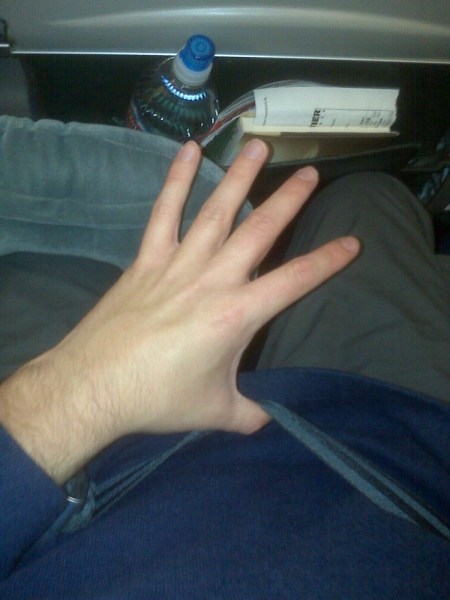
Yesterday, I boarded an airplane for my flight back home from Denver to Los Angeles.  As I was settling into seat 21C, I looked up and saw a very large man making his way down the aisle.  He was over 6 feet tall, and probably over 350 pounds  He was walking sideways, sort of, at an angle so he wouldn’t collide into every seat as he walked passed them, with his arms up, his elbows above the headrests.  His eyes were darting back and forth, registering which aisle seats already had people sitting in them, and taking care as he passed, so he wouldn’t bump into them.  When he got to me, he paused, checked his ticket, and sat down across the aisle, in seat 21D.

I was sitting across the aisle from my former self.

It’s not easy or comfortable to fly when you’re 400 pounds, as I was before I began losing weight.  I hated every moment of it, starting from my arrival at the gate.  This is when I would start looking around and sizing up the other passengers – literally.  I would look and see if there was anyone else as big as me.  More often than not, I would be the biggest person on the flight, and all I could think was that everyone else was noticing me and hoping that they wouldn’t be sitting next to me.  Maybe they’ve sat next to obese people before.  Maybe they’ve had to experience now rolls of fat spill over the armrest and into their space, sometimes making it difficult to operate the controls of the little TV in the seat back in front of them.  I used to think, as we waited to board the aircraft, that I can’t blame those people that were hoping I was in some other row.  I wouldn’t want to sit next to me either.

When booking air travel, a top priority was not to book a middle seat.  Window or aisle was always preferred, and I would oscillate between which I wanted more.  If it was a red-eye or a long flight where I would want to try to sleep, I would pick a window seat, so I could shift my weight slightly, and lean against the side of the plane the entire time.  That way, I would be doing everything I could to keep all parts of my body in my seat and my space, instead of intruding in the space of the person sitting next to me.  But if the flight was shorter, or during a time when I knew I probably wouldn’t be able to nap,  I’d pick an aisle seat.  In an aisle seat, I could stick one of my long legs into the aisle, which felt nice, and I could shift my weight slightly and lean into the aisle, as to not bother or intrude in the space of the person next to me.  This, by the way, is an excellent way to get smacked by the drink cart every time it passes.

Ultimately, it was lose-lose, because I was never comfortable on a plane.  I couldn’t lower the tray table, because my gut was too big.  I had to sit the entire time with my arms somehow crossed (which made reading a book challenging), because I couldn’t let them rest at my sides, as my sides were already pouring over the tops of the armrests, so resting my arms over that would put them fully in the seat (or the lap) next to me.

Worst of all was the seat belt.  I was too big for the seat belt.  It’s been years and years since I could wrap it around me and click it shut.  I would have to ask for a seat belt extender, which was always a mortifying experience, because I was certain everyone within four rows of me could hear me and were judging me.  I used to love the flight attendants who would just smile or nod when I asked them for one, and then, minutes later, just slip one to me nonchalantly as they walked by, without even making eye contact, like it was a drug deal or a hand-off in a spy movie.  Finally, about 6 years ago, I got tired of drawing attention to myself, and just stole a seat belt extender.  It became a permanent item on my checklist when I was packing.  Cell phone charger?  Check.  Toothbrush?  Check.  Seat belt extender?  Check.

Yesterday, I wondered if the man sitting in 21D was thankful for the considerate flight attendant on our flight, who was very discreet about delivering a seat belt extender, although I did catch the transaction out of the corner of my eye.  I know I smiled at that moment, and, to be honest, my eyes watered, because I had just buckled my seat belt minutes before, and I didn’t need a seat belt extender.  I left it at home.  Now that I’ve lost nearly 150 pounds, I can fit in the regular seat belt just fine, and with room to spare!

I know I’m never going to be really comfortable on planes.  I’m 6’4″, so my legs will always be cramped, and the head rest often hits me at my neck.  But, boy, how things have changed.  When I stand in the terminal, I don’t feel like all eyes are on me.  I can lower the tray table completely.  My body fits comfortably between the armrests, and no parts of me spill over the tops of them.

I’m just a guy on an airplane, not the fat guy on an airplane.

Keep it up, David!

Source:- https://keepitupdavid.wordpress.com/2010/11/28/how-a-400-pound-man-flies/