Showing posts with label losing weight. Show all posts

Wednesday, 9 December 2015

Are You Waiting to Buy Clothes Until You Lose Weight?

 Thank you Carol Brailey...........REALLY good advice!
====================================
Are you in the midst of losing weight and as a result are holding off purchasing new clothes in order to save time and money? OR I'm sure we have all heard someone say something along the lines of "I'm not going to buy new clothing until I lose some weight."
To this mindset I always say - What are you waiting for? Have you considered the opportunities that may be bypassing you in the meantime? There is no reason to put your life and goals on hold just because you have weight to lose.
Let me demonstrate this concept further with a fictitious illustration -- Sally has made a resolution to lose weight and has decided to hold off purchasing new clothing until she is at her ideal weight, which may take up to 9 months perhaps longer. At the same time, she also would like to be promoted at work and find romance. Her existing wardrobe is not reflecting how she would like to be received at work or on the dating scene.
Is it wise for Sally to continue wearing clothing to work and social engagements (including dates) that does not give off her best energy for the next 9 months, possibly more? Absolutely not! She is putting her work and romance goals at risk.
During times of weight transition, to be time- and budget-smart while maximizing your image potential, follow these 4 easy steps to ensure the image you are displaying is in alignment with your short-term goals:
1.Take an inventory of your short-term goals.
Estimate and write down how long it will take you to achieve your desired weight. Then write down your short-term goals that you want to achieve during your weight transition. Some examples may include: job change/promotion, finding romance, attract more clients/sales etc.
2.Take an inventory of your short-term image goals.
For each short-term goal identified in step #1, write down the image you would like to project in order for the goal to be successfully achieved.
For example if you would like to be promoted at work, the image you would like to project may include words like professional, modern, vibrant, powerful and respected.
3.Take an inventory of your current wardrobe and identify gaps.
Review your current wardrobe in light of your short-term image goals identified in step #2. Identify where you can fill in the gaps between your current wardrobe and your short-term image goals. Sometimes you can work with many pieces in your existing wardrobe and just add in a few key staple pieces that are new.
For example, let's say you are looking to change jobs and you own a classic suit that is still a reasonable fit that works great for job interviews. However, all of the blouses you currently own that go with the suit are outdated (which translates to old-fashioned, resistant to change, outdated thinking). It is very possible that you only need to fill in a gap by adding a new blouse in your color palette and style to refresh the outfit. You could attract a dream job and a salary increase just by spending a small amount of money on a new blouse!
4.Fill in the gaps.
Now it's time to fill in the gaps identified in step #3 by going shopping! Also keep your eyes open for items that can be easily altered during your weight transition.
Now you have 4 easy steps to ensure the image you are displaying is in alignment with your short-term goals during weight loss. You will more than likely want to repeat the above 4 steps periodically throughout your weight loss because as clothing becomes looser, it may not align with your image goals (i.e. the suit in the example above more than likely will not look professional if it becomes extremely loose).
There is no reason to put your goals on hold just because you have some weight to lose. All we really have is the present. Give off your best and most authentic energy today to attract the opportunities your heart desires!
I hope this blog post inspires you to wear your authenticity!

Source:- http://www.huffingtonpost.com/carol-brailey/are-you-waiting-to-buy-cl_b_6354210.html

Sunday, 1 February 2015

How A 400-Pound Man Flies

Yesterday, I boarded an airplane for my flight back home from Denver to Los Angeles.  As I was settling into seat 21C, I looked up and saw a very large man making his way down the aisle.  He was over 6 feet tall, and probably over 350 pounds  He was walking sideways, sort of, at an angle so he wouldn’t collide into every seat as he walked passed them, with his arms up, his elbows above the headrests.  His eyes were darting back and forth, registering which aisle seats already had people sitting in them, and taking care as he passed, so he wouldn’t bump into them.  When he got to me, he paused, checked his ticket, and sat down across the aisle, in seat 21D.

I was sitting across the aisle from my former self.

It’s not easy or comfortable to fly when you’re 400 pounds, as I was before I began losing weight.  I hated every moment of it, starting from my arrival at the gate.  This is when I would start looking around and sizing up the other passengers – literally.  I would look and see if there was anyone else as big as me.  More often than not, I would be the biggest person on the flight, and all I could think was that everyone else was noticing me and hoping that they wouldn’t be sitting next to me.  Maybe they’ve sat next to obese people before.  Maybe they’ve had to experience now rolls of fat spill over the armrest and into their space, sometimes making it difficult to operate the controls of the little TV in the seat back in front of them.  I used to think, as we waited to board the aircraft, that I can’t blame those people that were hoping I was in some other row.  I wouldn’t want to sit next to me either.

When booking air travel, a top priority was not to book a middle seat.  Window or aisle was always preferred, and I would oscillate between which I wanted more.  If it was a red-eye or a long flight where I would want to try to sleep, I would pick a window seat, so I could shift my weight slightly, and lean against the side of the plane the entire time.  That way, I would be doing everything I could to keep all parts of my body in my seat and my space, instead of intruding in the space of the person sitting next to me.  But if the flight was shorter, or during a time when I knew I probably wouldn’t be able to nap,  I’d pick an aisle seat.  In an aisle seat, I could stick one of my long legs into the aisle, which felt nice, and I could shift my weight slightly and lean into the aisle, as to not bother or intrude in the space of the person next to me.  This, by the way, is an excellent way to get smacked by the drink cart every time it passes.

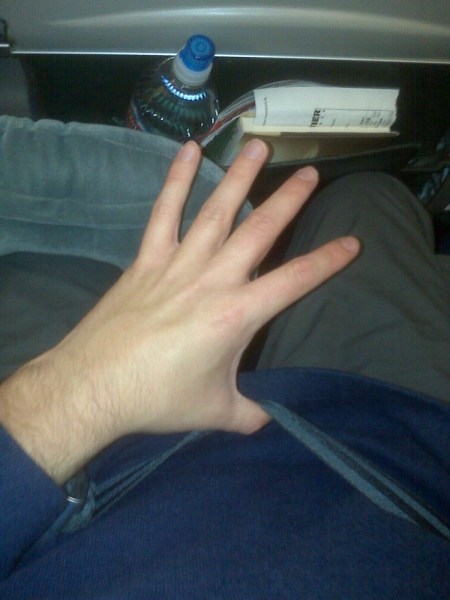
Ultimately, it was lose-lose, because I was never comfortable on a plane.  I couldn’t lower the tray table, because my gut was too big.  I had to sit the entire time with my arms somehow crossed (which made reading a book challenging), because I couldn’t let them rest at my sides, as my sides were already pouring over the tops of the armrests, so resting my arms over that would put them fully in the seat (or the lap) next to me.

Worst of all was the seat belt.  I was too big for the seat belt.  It’s been years and years since I could wrap it around me and click it shut.  I would have to ask for a seat belt extender, which was always a mortifying experience, because I was certain everyone within four rows of me could hear me and were judging me.  I used to love the flight attendants who would just smile or nod when I asked them for one, and then, minutes later, just slip one to me nonchalantly as they walked by, without even making eye contact, like it was a drug deal or a hand-off in a spy movie.  Finally, about 6 years ago, I got tired of drawing attention to myself, and just stole a seat belt extender.  It became a permanent item on my checklist when I was packing.  Cell phone charger?  Check.  Toothbrush?  Check.  Seat belt extender?  Check.

Yesterday, I wondered if the man sitting in 21D was thankful for the considerate flight attendant on our flight, who was very discreet about delivering a seat belt extender, although I did catch the transaction out of the corner of my eye.  I know I smiled at that moment, and, to be honest, my eyes watered, because I had just buckled my seat belt minutes before, and I didn’t need a seat belt extender.  I left it at home.  Now that I’ve lost nearly 150 pounds, I can fit in the regular seat belt just fine, and with room to spare!

I know I’m never going to be really comfortable on planes.  I’m 6’4″, so my legs will always be cramped, and the head rest often hits me at my neck.  But, boy, how things have changed.  When I stand in the terminal, I don’t feel like all eyes are on me.  I can lower the tray table completely.  My body fits comfortably between the armrests, and no parts of me spill over the tops of them.

I’m just a guy on an airplane, not the fat guy on an airplane.

Keep it up, David!

Source:- https://keepitupdavid.wordpress.com/2010/11/28/how-a-400-pound-man-flies/

Monday, 19 January 2015

The Secret To Losing Weight From A Former Fat Guy

A woman relaxes in bed with a book.
Photo, Getty Images.
It’s been 20 years since I was overweight, and I’ve learned a lot of tips and tricks for staying lean over the years. Think of this as part two to my last article about losing weight without losing your sanity. In this article I’m going to expand on the benefits of going to bed a little hungry.
Anyone who’s read my columns knows I eschew weight loss “miracles” and “magic,” but the trick of going to bed hungry is not that well known, especially when you consider how powerful it is as a tool for weight loss.
But it’s not always easy to do, and I’ll explain how to manage it later. First, let’s get into why you should do it.
It’s important to understand that when it comes to weight loss, calories are everything — the fundamental math has been proven time and again. This trick has nothing to do food getting stored as fat when you eat before bed – that’s a myth – and everything to do with restricting caloric intake in a smart way. The reason this trick works is because going to bed hungry is the only time of day it’s okay to be hungry!
“Obese people tend to eat little in the morning and much in the afternoon and evening,” wrote nutrition researcher France Bellisle in the Scandinavian Journal of Nutrition. “In extreme cases, a ‘night-eating syndrome’ is observed.”
The importance of eating breakfast isn’t about “revving up metabolism” – another myth – but establishing a healthy meal pattern that keeps you satisfied during the day. If you allow yourself to get hungry during the day, it builds. It builds to the point where, come the end of the day, willpower is overwhelmed and you can be tempted to stuff in lots of unhealthy calories before bed, taking in too much overall for the day and not achieving your desired weight loss.
The smart way to restrict calories is to eat three or four satisfying meals and then after dinner, stop eatingGoing to bed a little hungry, a number of days each week, is going to drop the pounds. It’s the smart way to do it because your appetite resets overnight, and you don’t have to worry about runaway “night eating” later on. You start fresh with breakfast the next morning.
Be cautious, however, not to go to bed so hungry you wake up in the middle of the night needing to raid the fridge.
That’s the why, now here are three tips on how to do it:
1. Establish a meal patternAs I mentioned above, it’s important to focus on three or four meals at regular intervals during the day. Snacking is to be limited as a way to fuel exercise by eating something healthy. The focus should be on eating at regular intervals like breakfast, lunch and dinner.
2. Have all your meals at the dinner tableDoing things like eating on the couch, at your desk or in your car create a snacking mentality that allows you to eat anywhere, at any time. When you program your brain to think that you should only be eating while seated at a proper table (to focus on eating and nothing else) then it makes it a lot easier to resist snacking.
3. Beat late-night snackingThese are a number of tricks, because you may find that at around 9 p.m. you’re starting to feel that hunger, and you want that snack. You need to power through another hour or so to make it until, and here are some tactics to succeed:
a) Realize that it may be boredom instead of hunger. Chances are you’re busy all day long, and this is the time you’re finally not busy. You’re used to always doing something, and eating is doing something, so you eat. Things you can do instead of eating to relieve this boredom are to stretch, take a short walk, call or send an email to a friend you haven’t spoken with for a while, play a game or write in a journal.
b) Chew gum.
c) Brush your teeth. Most people associate this with an inability to eat so give it a try.
d) Have some hot herbal tea. Make it hot enough so that it takes time to drink in small sips. Don’t burn your tongue, though.
e) Go to bed and read.
Again, you don’t have to do this every day, and you don’t want to be starving, but just a little hungry. Remember that it needs to be coupled with a focus on being “satisfied” during the day rather than “full.” Throw in a regular exercise routine and you’ll be on your way to a healthier, leaner you.

Source:- http://www.chatelaine.com/health/fitness/the-secret-to-losing-weight/

Tuesday, 9 December 2014

'My Husband Loves It When I Attract Male Attention Now': Mother-Of-Four Mortified By Sight Of Her 'Fat Legs' At Ascot loses 6st


  • Melody Feldsted, 33, from Slough, weighed 16st 3lb and wore size 20 
  • Mortified at Facebook photo of her at Ascot with 'fat legs' and a 'wide face'
  • She slashed her calorie intake by 25% and hit the gym
  • Also quit smoking, and she now weighs 10st 11lb and fits into size 10
Melody Feldsted, 33, from Slough, saw her weight creep up after the birth of her first child when she was 18. At her heaviest she weighed 16st 3lb and wore size 20 clothes. 
Today, after slashing her calorie intake by 25 per cent, hitting the gym and quitting cigarettes, her weight is a healthy 10st 11lb and she can fit into size 10 outfits.
The picture of Melody at the Ascot races in August 2012 which encouraged her to lose weight
Melody pictured recently, weighing 10st 11lb
The picture of Melody at 16st 3lb the Ascot races in August 2012 which encouraged her to lose weight (l) and Melody pictured recently, weighing 10st 11lb (r)
She said a photo of her in her Sunday best taken at Ascot in the summer of 2012 shocked her into taking decisive action.
Mrs Felstead, a former shop assistant, said: 'I looked at the photo and thought, "oh my God, that can't be me".
'I looked overweight and unhealthy. I wondered how I'd allowed myself to get like that, and why anyone had allowed me to go out looking so large.
'I hated the way my legs looked fat, and my face appeared very wide. It was a nice dress and I didn't do it justice at all. I couldn't stand the thought that it had been shared with other people - I asked my friend to take it down.'
Mrs Felstead, who is 5ft 6in tall, saw her body shape change after the birth of her sons Jordan, now 15, Bradley, 11, Brendan eight, and Mikey, three.
Her weight topped 13st following the birth of her youngest son, and Mrs Felstead saw the pounds pile on rapidly following her decision to quit her 20-a-day smoking habit in January 2011.
Melody on a family holiday to Turkey in April 2012 before she lost weight
She says she only wore a swimsuit because she was overseas and knew no-one I knew would see her in it
She said: 'I wasn't consciously aware of eating more, but I was gaining weight. I expect my metabolism slowed down and I was subconsciously substituting cigarettes for snacks.
'I enjoyed biscuits - custard creams, shortbread and Jammie Dodgers. I took me a long time to realise that eating biscuits adds a lot to your daily intake.'
As her weight crept up, Melody became more and more self-conscious.
'I was really embarrassed about the way I looked in a swimsuit - I looked far too large and unhealthy. I only wore it because I was overseas and knew no-one I knew would see me in it. If I'm around people I know, I never wear swimsuits. 
'I tried not to care what people thought, but inside I was very unhappy.'
Melody pictured with her husband Jamie before she lost weight. Now, he has to contain his jealousy
But it was the Ascot photograph was the final straw.
She said: 'One of my friends put the picture on Facebook, which was mortifying. They told me they didn't think I was particularly large, but I thought I looked huge.'
Mrs Felstead decided to join a local gym where she and her husband Jamie, 34, an electrician, both took advantage of a special offer which granted them annual membership at a discounted rate.
'I was really embarrassed about the way I looked in a swimsuit... I only wore it because I was overseas and knew no-one I knew would see me in it'
 
She said: 'We had an induction where I was weighed for the first time in as long as I could remember. When the scales reached 16st 3lb I was shocked.'
She began going to the gym three times a week, tackling a wide variety of cardiovascular exercises including running and cross training.
She also began counting calories, slashing her intake. Within a year she'd lost five stone. 
She said 'I didn't change the food I was eating - I just made sure I ate sensible portions. I didn't want to make too many drastic changes because I wanted the changes to be sustainable.'
Today she typically eats porridge with blueberries or raspberries for breakfast, followed by soup with sliced bread for lunch, and a portion-controlled square meal with her children, such as spaghetti
bolognese or lasagne.

Melody's diet before

Breakfast: Nothing
Lunch: Chicken wrap with chocolate and crisps
Dinner: Lasagne with garlic bread
Snacks: Biscuits, shortbread and Jammie Dodgers

Melody's diet after

Breakfast: Porridge with blueberries or raspberries 
Lunch: Soup with some sliced bread 
Dinner: Portion-controlled square meal
Snacks: Fruit
A glamorous picture of Melody part-way through her weightloss journey, as her confidence grows
Her combination calorie-counting and regular exercise has paid off, as today she tips the scales at 10st 11lb and can fit into size 10 clothes. 
She said her husband Jamie, her partner of 16 years, has had to learn to deal with the attention she now gets on a night out.
She said: 'Not long ago a big group of us went out as wives and husbands. At one point the wives were in one part of the bar, and the guys were in another. Another group of lads approached and started looking me and my friends up and down.
'One of the other husbands was a bit put out that they seemed interested in us, but Jamie's response that he was proud I was so good-looking.
Melody pictured at Christmas
Melody pictured recently, weighing 10st 11lb
Melody pictured at Christmas (left) and more recently, weighing 10st 11lb
When she looks at the Ascot photo now, she says it doesn't look anything like her.
'I look and feel like a completely different person. I hate looking at it, although it does make me appreciate how far I've come and what I've achieved in losing the weight.'
This weekend Mrs Felstead is taking part in her first ever half marathon at Silverstone. She hopes to complete the 13-mile course in under two hours. 
She said: 'I'd signed up for the run ages ago in the hope I'd be fit and healthy enough to do it. The fact that I feel confident enough to take part and achieve a good time is a huge milestone for me.
'I'm proud of what I've achieved. It's so much easier to keep up with the children and I'm even more confident.
'I'm so happy I can fit into the clothes I love, instead of the frumpy old clothes that I used to have to wear.'


Source:- http://www.dailymail.co.uk/femail/article-2570114/My-husband-loves-I-male-attention-Mother-four-mortified-sight-fat-legs-Ascot-loses-6st.html

Thursday, 13 November 2014

Tired Of Dieting? Stop It! It May Not Work

If you've been on a diet, you know the ups and downs. At first you're excited and motivated. You start to lose weight, but after awhile, the restrictive eating starts to wear off and you begin eating like you used to. The weight comes back and you start searching for a new diet.
Sick of dieting? Well, stop it then. Research shows most diets usually end in failure.
Researchers at UCLA recently looked at 31 diet studies and concluded that the majority of people who go on a diet end up putting back all of their weight. Two-thirds put back on even more weight. Why does this happen?
"When you diet, your metabolism slows down, or becomes more efficient, as a normal biological response," said Joy Musselman, registered dietitian at McKay-Dee Hospital. "Our bodies are designed to conserve energy when food is less available in an effort to sustain life in times of food scarcity. When we diet and severely restrict our food intake, our body responds by decreasing the amount of calories we burn."
There are thousands of diets out there, but Musselman said dieting is a poor method for losing weight long-term. Usually one goes on a diet as a short-term plan to lose weight, and often weight loss can be seen initially.
"However, once you revert back to the lifestyle habits that caused you to gain weight in the first place, the weight you lost while dieting returns and, typically, brings with it some additional weight. Many of us have a history of dieting to lose weight and then regaining weight and repeating this cycle over and over," she said. "However, each time we repeat the cycle, we are unable to lose as much weight as we did previously and we regain more than we ever have before. Each time we go through the dieting cycle, we impact our metabolism so that losing weight in the future is more and more difficult."
According to Dr. Pamela Peeke, a physician who regularly blogs on WebMD, dieting is stressful. That's because when you restrict calories, the stress hormone called cortisol increases. Not only does this cause anxiety, but it causes cravings as well.
Musselman agrees.
"Cravings are powerful motivators to eat, making it more difficult for us to resist food, particularly sweet, starchy, and salty foods," she said. "Imagine if someone told you that you could never have chocolate again. What would happen? For those of us that love chocolate, our cravings for chocolate would significantly increase."
Dieting works in the same way, Musselman said. That isn't to say that our cravings won't subside over time, but it does explain why we experience so many powerful cravings each time we start a diet or eliminate foods from our eating plan.
Dieting also makes you hungry. A study published in the New England Journal of Medicine states that when obese people diet, their appetite hormones spike. Those hormones stay high up to a year after they've lost the weight. Researchers at the University of Melbourne who conducted the study, said the body rebels when it isn't eating enough, so the hormones tempt the person to eat.
It is possible to lose weight and still enjoy food of every kind, however.
The key, Musselman said, is moderation.
"Americans, in general, consume excessive amounts of fat, sugar, and salt. Becoming more moderate in our intake of sugary, salty, high-fat foods will help us to lose weight but still allow us to occasionally enjoy higher calorie, less nutritious foods," she said. "We also don't consume enough fruits and vegetables. Increasing our intake of produce can not only help us to lose weight but will also improve our overall health and well being."
In her blog, Peeke suggests ditching the diet mentality and start saying you are practicing healthy lifestyle habits instead. That way, you aren't obsessing about every pound and every morsel of food you ingest.
"An important part of healthy weight loss will be recognizing those times when we tend to eat for reasons other than hunger," Musselman said. "Food is very abundant and many times we eat because food is readily available and convenient rather than because we are truly hungry."
She said to think of the office candy jar as an example. You don't usually grab a piece or two of candy because you are hungry. You eat it because it's visible and convenient. Emotional eating is also a common cause of weight gain and must be addressed in order to successfully lose weight long-term.
"Food does not make a great coping mechanism for stress, anger, boredom, frustration, or loneliness," she said. "While weight loss is important, you should never compromise your overall health while trying to lose weight. Diets that encourage you to severely limit the variety of foods you consume are not healthy for you. For a weight loss plan to be effective long term, there must be an emphasis on making lasting lifestyle changes that include becoming more active as well as adhering to healthy eating principles."

Source:-http://e.standard.net/stories/2014/04/29/tired-dieting-stop-it-it-may-not-work 

Wednesday, 22 October 2014

Food Addiction – A Serious Problem With a Simple Solution

Food Addiction – A Serious Problem With a Simple Solution

This article contains detailed information on addiction to food. It explains exactly what it is, how it works and what you can do to overcome it.
Eating healthy and losing weight seems downright impossible for many people.
Despite their best intentions, they repeatedly find themselves eating large amounts of unhealthy foods, despite knowing that it is causing them harm.
The truth is… the effects of certain foods on the brain can lead to downright addiction.
Food addiction is a very serious problem and one of the main reasons some people just can’t control themselves around certain foods, no matter how hard they try.
Girl Who is Addicted to Chocolate

What is Food Addiction?

Food addiction is, quite simply, being addicted to junk food in the same way as drug addicts are addicted to drugs.
It involves the same areas in the brain, the same neurotransmitters and many of the symptoms are identical (1).
Food addiction is a relatively new (and controversial) term and there are no good statistics available on how common it is.
This is very similar to several other eating disorders, including binge eating disorder, bulimia, compulsive overeating and having an “unhealthy” relationship with food.

How This Works

Processed junk foods have a powerful effect on the “reward” centers in the brain, involving brain neurotransmitters like dopamine (2).
The foods that seem to be the most problematic include typical “junk foods,” as well as foods that contain either sugar or wheat, or both.
Food addiction is not about a lack of willpower or anything like that, it is caused by the intense dopamine signal “hijacking” the biochemistry of the brain (3).
There are many studies that support the fact that food addiction is a real problem.
The way this works is pretty complicated, but this short video explains it in human terms:

8 Symptoms of Food Addiction

There is no blood test available to diagnose food addiction. Just like with other addictions, it is based on behavioral symptoms.
Here are 8 common symptoms that are typical of food addicts:
  1. You frequently get cravings for certain foods, despite feeling full and having just finished a nutritious meal.
  2. When you give in and start eating a food you were craving, you often find yourself eating much more than you intended to.
  3. When you eat a food you were craving, you sometimes eat to the point of feeling excessively “stuffed.”
  4. You often feel guilty after eating particular foods, yet find yourself eating them again soon after.
  5. You sometimes make excuses in your head about why you should eat something that you are craving.
  6. You have repeatedly tried to quit eating or setting rules (includes cheat meals/days) about certain foods, but been unsuccessful.
  7. You often hide your consumption of unhealthy foods from others.
  8. You feel unable to control your consumption of unhealthy foods, despite knowing that they are causing you physical harm (includes weight gain).
If you can relate to 4-5 of these, then you probably do have a serious problem with food. If you can relate to 6 or more, then you are most likely a food addict.

Food Addiction is a Serious Problem

Woman Snorting Doughnuts, Large
Although the term “addiction” is often thrown around lightly, having true addiction is serious business.
I’m a recovering alcoholic, smoker and drug addict with a history of many rehabs, jail more often than I can count and several trips to the emergency room due to overdose.
After I had been sober for several years, I started to develop an addiction to unhealthy foods.
Full-blown addiction. Nothing more, nothing less.
The reason I’m telling you this is to demonstrate that I know how addiction works.
I’m here to tell you that food addiction is the same as addiction to drugs… exactly the same.
The symptoms and thought processes are completely identical. It’s just a different substance and the social consequences aren’t as severe.
Food addiction can cause physical harm. It can lead serious diseases like obesity, type 2 diabetes, heart disease, cancer, Alzheimer’s, arthritis and depression, to name a few.
But you have even bigger reasons to quit than some unfamiliar disease in your distant future. Food addiction is also ruining your life… today.
It breaks your self-esteem, makes you unhappy with your body and can make your life a living hell (like it did for me).
The seriousness of being a food addict can not be overstated. This is a problem that ruins lives and kills people. Literally.

The Law of Addiction – Why You May Never be Able to Eat “Normally” Again

Young Woman Feels Bad About Eating Junk Food
The most important lesson I have ever learned is called the law of addiction:
“Administration of a drug to an addict will cause reestablishment of chemical dependence upon the addictive substance.”
A former smoker who has a puff of a cigarette will become addicted again… instantly.
An alcoholic who has a sip of beer will relapse, with all the horrible consequences that follow.
There is no way of getting around it. This is simply how addiction works.
I am personally convinced that food addiction is no different. One bite of cake, one sip of coke, one “cheat” – that’s all it takes.
Of course, we all need to eat something. Otherwise we’ll die of starvation. But no one needs to eat sugar, refined wheat flour or any of the modern junk foods that people tend to lose control over.
Most food addicts will never be able to eat junk food like “regular” people again. That’s the cold, hard truth.
But if they manage to avoid the “trigger foods,” then they should be able to eat healthy and lose weight without problems.
The truth is… complete abstinence is the only thing that reliably works against addiction. The sooner you accept that, the sooner you will recover.
Although the “everything in moderation” message may work for some people, this advice is a complete disaster for food addicts.
When it comes to addiction, moderation fails. Every time.
This is the simple (but not easy) solution to addiction. Avoiding the addictive substance at all times.
Source:-  http://authoritynutrition.com/how-to-overcome-food-addiction/

Wednesday, 16 July 2014

Love Yourself... Diet

MIND & BODY

Love Yourself... Diet

Give yourself exactly what you need—and losing weight will be just one benefit.


Love Yourself... Diet
 courtesy of Shutterstock
Matzo ball soup, guacamole and chips—these are the foods I eat when I’m in the mood to celebrate. I drown my sorrows with Ben & Jerry’s Coffee Heath Bar Crunch. And when I’ve taken too many trips to the freezer and too few to the gym, I punish myself by withholding the foods I love. Like a lot of women I know, my relationship with food is complicated: I look to it more for joy, solace, companionship (even repentance!) than for nourishment. But I’m learning that it doesn’t have to be that way. You don’t need to starve yourself—or beat yourself up for not starving yourself—to lose weight. Instead, discover how to nurture yourself and create a healthier, happier relationship with food—and your body.

LOVE-YOURSELF STRATEGY: Learn to eat mindfully 
To kick the habit of overeating, turn your attention toward food rather than away from it. When you sit down to eat, relish each morsel. Notice the color, shape, texture, and aroma, as well as the taste. If you’re eating with friends or family, talk about how the meal was made and where it comes from. Even when indulging in a fast-food meal, take it home and enjoy it properly: Put it on a plate and eat with cutlery by candlelight!
HOW IT HELPS: Mindfulness, which can include deep breathing and meditation, helps you become more aware of the reasons you’re eating, says Jeffrey Greeson, Ph.D., a health psychologist at Duke Integrative Medicine. “Often we eat not because we’re hungry but because we’re stressed, frustrated, or bored.” Mindfulness lets you catch impulses as they crop up and teaches you to sit with difficult feelings and respond to them in a healthy way instead of using food as a buffer. It can also make eating more satisfying, which may help you eat less.
GET STARTED: Start today with a shopping trip to your favorite market. Choose foods that delight your senses—juicy fruits, colorful vegetables, and high-quality chocolate. Once back in your kitchen, take the time to prepare a meal that looks and tastes appealing.

LOVE-YOURSELF STRATEGY: Savor low-density foods 
Forget the idea that to lose weight you have to feel hungry all the time. Instead of depriving yourself, satisfy yourself with low-energy-density foods like fruits and vegetables, wholegrain breads, and broth-based soups; they’re filling without being high in calories or fat.
HOW IT HELPS: In a one-year study of 97 obese women (conducted by Barbara Rolls, a nutrition researcher at Pennsylvania State University and creator of the Volumetrics Eating Plan), those who filled their plates with low-density foods ate more but still lost 3.3 pounds more than those who ate less and restricted fat. In separate studies, Rolls and colleagues found that women who ate a large green salad or a bowl of broth-based soup before a meal consumed fewer calories than those who went straight to the main course.
GET STARTED: Create meals around legumes, fruits, vegetables, and lean protein, and when shopping for packaged foods, learn to check the labels. A food has a low-energy density if the number of calories is lower than its weight in grams. (For example, one half cup of black beans weighs 130 grams but contains only 100 calories, so it’s considered a low-density food.)

LOVE-YOURSELF STRATEGY: Embrace complex carbs 
Simple carbs like white flour, refined sugar, and white rice spike your blood sugar and leave you hungry soon after you eat. For a more satisfying meal, choose complex carbs like brown rice, beans, non-starchy veggies (leafy greens, peppers, and cucumbers), whole-grain pastas and breads, and most fruits; they’re all low on the glycemic index, meaning the sugars are absorbed more slowly into your bloodstream, keeping blood sugar steady.
HOW IT HELPS: Researchers at Harvard University found that obese patients who lost weight by eating foods low on the glycemic index reported less hunger and kept off the weight longer than those who lost weight on a typical low-fat diet.
GET STARTED: To find foods that are low on the glycemic index (scores of 55 or less), go to glycemicindex.com.
by- See more at: http://www.naturalhealthmag.com/mind-body/love-yourself-diet#sthash.DKMtW2rC.dpuf