Showing posts with label fat. Show all posts

Thursday, 7 April 2016

My History Of Being Fat

I was born 10 pounds, 7 ounces; fat from the get-go. There are pictures of my mother pregnant with me, walking around our neighborhood with my costumed brother on Halloween, the day before I was born. She is enormous. I am enormous inside of her. Nobody cares if you’re fat when you’re a baby. They say things like:There’s more of her to love, or Look at those chubby cheeks. And they mean it.
There were years I was an average weight, I think, but I was certainly fat by elementary school. I recall stopping by a friend’s house in the neighborhood once to see if she wanted to play with me, but finding only her mother home. The next day at school, my friend and some of the other little girls in our class laughed as I approached. “What’s so funny?” I said. “I heard you came over yesterday,” she said. “My mother said a husky girl knocked on the door. I asked her what ‘husky’ meant and she said it meant ‘fat’ and then I knew it was you.” Husky, they all laughed at it.
A new vocabulary word for them, but not for me. I knew so many more words than they did. Also, I knew that Husky dogs were from Alaska and had beautiful fur and could race sleds. Why bother sharing information with these girls?

I remember going to a birthday party at another  friend's house and playing a video game, checking out already from the world around me.  I was so chubby that my pants rode down below my waist and my butt crack was revealed.  Some boys stood behind me and shot a water gun at me, down my pants.  I swiveled my head, appalled, and pulled down my shirt.  And then I turned back to the video game and continued to play. I was approaching a high score.

I'm certain that all of this hurt my feelings. I am trying to remember what that pain felt like, but I have been in a perennial state of not letting it bother me for decades. 
Maybe I went home and cried. I wish I could remember. Let’s pretend I went home and cried. It’s probably true. 
In junior high school, in the advanced English class, our teacher engaged us in a verbal exercise. She wanted us to learn about the powers of description. So she had us all stand up in a circle, and everyone had to go around the room and say one word to describe the person standing. Funny, smart, etc. And when it was my turn to stand, a boy named Mark said, “Thunder thighs.” Mark, you idiot, that’s two words. Even now, that’s all I’ve got in terms of a comeback. I was never that good with the burns.
Why was I fat? Where do I start? I was fat because I loved books more than people and instead of playing with other kids, running around and getting exercise, I had my nose stuck in a damn book. I was fat because my parents were a little fat themselves at that point in their lives, and I ate what they ate. I was fat because I was a latchkey kid, so I would go home and eat whatever I could get my hands on in the house. And I was fat because part of me didn’t give a shit; I already lived the life of a mind, and I didn’t care how I appeared to the outside world, so satisfied was I in my imagination. I was fat because I lived in the Midwest in the 1970s and everyone was a little fat then, and only getting fatter.
High school: tits and ass, not-so-fat, but never skinny. I dated very little, and sometimes I cared, and sometimes I didn’t. I started going on runs, right before I went to bed. I liked the way I felt at the end of the run. The streets of the suburbs were quiet at night. I used that time to picture a life anywhere but there. I hated high school. I would feel like a fat girl forever. I think I realized that even then.
College: As much late night drunk eating as my heart desired. Freshman twenty. Also I started smoking weed somewhere in there, and discovered the pleasures of eating while stoned. Every vice begat another. Gateway chub.
And then it was up and down for a decade. I started having sex, and, in my mind, as long as I was having sex, I was attractive, which means I couldn’t be too fat, now could I? Sex as a guideline for physical health. How about that. That’s how I saw it in my twenties. That’s not how I see it now.
It is the year 2000, and I weigh around 200 pounds, a fact of which I am unaware because I never get on a scale. (Although I find it out a few weeks later in the bathroom at my brother’s house, finally too curious to resist.) I am sleeping with a man who is not a very nice man, and perhaps not even particularly attractive, but he is quick-witted and sort of cool, and this covers up the not-nice part of him, at least for a period of time. Also, we are always fucked up in one way or another when we are together, either on booze or drugs, and I am still insistent on proving my own attractiveness to myself by having sex as regularly as possible, even if it is with terrible people. We are lying naked on his couch in his shitty Lower East Side basement apartment, and for some reason he is talking about other women he’s seeing, and I’m starting to feel terrible about myself. It’s this feeling that’s creeping slowly up my spine, an unfolding self-disgust, and then he says to me, “But you know, there’s something about a big girl,” and, after a pause, he pats my ass, and all of a sudden I realize he’s talking about me, I am that big girl.
It was another few years until I lost the weight. Lost, that’s what it felt like, that it disappeared one day when I wasn’t paying attention, and I never saw where it went. I wasn’t trying to lose weight, but I did. I went away for a summer to the woods in Northern California and started writing my first book. In exchange for a small cottage, I was tasked with taking a giant, cranky Tibetan Mastiff for hikes every day. I was introduced to yoga, and found that I loved it. There was no television, spotty internet access, and my cell phone barely worked. So I wrote. I wrote a collection of stories. I put my entire self into that book. And the book replaced the food. Whatever hole was in me that needed to be filled, writing books, for the most part has filled it. I realize this is not how it works for everyone, but this is how it worked for me.
But here’s the truth: If I could still eat like I did then, I would. I still do sometimes, though rarely. Definitely there are days when I cannot get full enough. But I enjoy being this thinner – but never thin – version of myself. I prefer my clothes fit in a certain way. And yoga and meditation have made me a happier person, stronger, more balanced, more capable of compassion, and a better writer. But most importantly: I want to live a long life. That, more than anything, is why I try to keep my weight in check. I have shit genetics in my family — cancer, heart attacks, all the fun stuff — and I have a lot I want to do over the next forty or fifty years, at the very least a lot of books I want to write, so I try to keep the goddamn weight in check, even when I don’t feel like it.
For the purposes of this piece, I got on the scale in the bathroom at the cafĂ© near my house this morning. (I don’t have a scale in my house, because what do I need a scale for when I have Amazon numbers to obsess over?) I was at 156 with my clothes on but my shoes off, probably because I ate an entire personal pizza the night before because I found out a certain publication wasn’t going to review my book. (What is it about eating an entire thing, I wonder? Is there a sense of accomplishment? Or perhaps it’s that there’s nothing left behind to remind you of what you just did.)
Maybe tomorrow I’ll weigh 154 if I eat better today, but as of right now I’m three pounds away from being technically overweight, 158 at 5’6” being the danger zone on that chart I found on the internet. So right now I’m fat-adjacent. This is the territory I will travel in for the rest of my life.
Look, I don’t smoke anymore. I don’t do drugs anymore. I don’t date men who are terrible for me. I still like to drink, but I prefer to get up in the morning with a clear head and write my books, so I’m less likely to drink all night long. What I have left is food; that is my vice. And I will always want to eat a pizza when I am feeling rejected. And thus, my history of being fat is my past, present, and future. In the back of my mind, there is always a possibility of return. Fat-adjacency. But I like being responsible to myself. I like taking care of me, as much as I love food. So here I am. Alive.
Jami Attenberg is the author of ‘The Middlesteins,’ a novel about food obsession, families, love, the Midwest, and other important topics.
Source:- http://thehairpin.com/2012/10/my-history-of-being-fat/

Monday, 7 December 2015

'Why Am I Fat?'


8 reasons you may be eating too much.

You're stuffed after a big restaurant dinner -- but then the dessert cart rolls around, and you just have to order that gorgeous chocolate mousse. Or you're munching from a big bag of chips while checking emails, and when you look up, the bag is empty. Sound familiar? 
Environmental factors -- like package size, portion size, the variety of food you're served, and the size of your plate -- can influence your eating more than you realize, experts say. Indeed, if we always ate only when we were really hungry and stopped when we were full, there would be no obesity epidemic.
The key, experts say, is to become more aware of these causes of overeating, which can help you resist the temptations and avoid weight gain.
"Once you become aware of the environmental cues that can sabotage your diet, you can react accordingly and make smart decisions," says nutrition expert Susan Moores, RD. Simple things such as bringing tempting snacks into your house, moving the candy jar at work out of sight, making fruits and vegetables more visible in your refrigerator, and eating more deliberately and slowly, can cut down on overeating and help you lose weight, Moores says.
Here are eight factors that can cause overeating and weight gain:
related content


SLIDESHOW

Busted: Popular Diet Myths

Go Here


1. Sights, Sounds, and Smells

Overeating can be triggered by the alluring smell of bacon cooking, the sound of popcorn popping, advertisements for junk food, and so on. "You are influenced by your surroundings, and our studies show these kinds of cues result in eating more food," says Cornell University researcher Brian Wansink, PhD, author of Mindful Eating.

2. Distracted Eating

"Eating amnesia" is the act of almost unconsciously putting food in your mouth, usually from a big bag or bowl while sitting in front of the television, reading a book, checking emails, or during happy hour.
It's also easy not to register the tastes you take while cooking, or those last few bites from the kids' plates that you finish off. 

Multi-tasking can lead to overeating because you're not paying attention to what you are eating. When you eat more mindfully, you really taste the food -- and are more likely to feel satisfied sooner. "Food should touch more of your senses to be satisfying, instead of just filling in the hole," Moores says.

3. Food, Food Everywhere

Everywhere you turn, there are opportunities to eat -- at drive-through restaurants, vending machines, even gas stations. And when food is in front of us, we tend to eat more of it, experts say.
Wansink and colleagues found that when candy was easily accessible on workers' desks, they ate an average of nine pieces a day, and didn't realize how many they ate. But when the candy was kept in their desk drawers, they ate about six pieces per day. And when they had to get up from their desks to reach the candy six feet away, they only ate four pieces.
Curb your instinct to overeat sweets and snacks by moving them out of sight -- and putting more healthful foods into plain view. Resist the urge to splurge on unhealthy foods by carrying your own healthy snacks.

4. Food that's Fast,Convenient, and Inexpensive

Fast-food restaurants on every corner offering inexpensive food also encourage us to eat more and more often. Combo meal deals sound like a bargain, but they are loaded with fat, sodium, and calories.
Also, "when you eat lots of fast food, it all starts to taste the same, and you can become satisfied with a small range of flavors and sometimes it is hard to get enough," says Moores.
To help yourself resist the temptation, work on developing a taste for the subtle, natural flavors of food, suggests Moores.
Dietitians recommend limiting visits to fast-food restaurants to once a week. And, they say, choose the healthier menu options -- like salads and grilled chicken sandwiches -- even if they cost a little more.

5. Portion Distortion

Our idea of a normal portion has become skewed, in part because so many restaurants serve oversized portions. "Giant portions seem to have evolved into the norm, and many people have trouble understanding how much they should eat," Moores says.
To understand what a portion should look like, pull out the measuring cups, and see how your portions stack up against WebMD's Portion Size Plate tool or the standards from the U.S. government's mypyramid.gov web site.
Another answer to the portion dilemma is to eat more foods that are less calorically dense. These are foods that contain lots of water and fiber, but not many calories -- like fruits, vegetables, salads, and broth-based soups. Researcher Barbara Rolls, PhD, and colleagues at Penn State University found that it's possible to reduce calories without increasing hunger by eating more of these types of foods.
Mindful eating can help here, too. "Eat slowly, taste the food and become more in touch with what you are eating and how it tastes so you can enjoy it more and start to appreciate satisfaction with smaller portions," Moores says.

6. Giant-Size Packages

You'll find plenty of bargains on mega-sized packages at super-discount stores like Costco or Sam's. But unfortunately, experts say, these giant containers can affect us on an unconscious level and cause us to eat more. Researchers have found that when you eat from a large container, you are likely to consume 25% to 50% more than you would from a smaller package -- especially when you're eating snacks and sweets.
"First, try to get out of the habit of always eating something while you are sitting, relaxing, or watching television," says American Dietetic Association spokeswoman Tara Gidus, MS, RD. "Try a cup of tea, glass of water, or chew a piece of sugarless gum. If you want a snack, portion it out of the bag or container or buy smaller packages like the 100-calorie snack packs."

7. Not-So-Dainty Dishware

Researchers have found that we tend to eat more when we're served from larger containers. Wansink and colleagues found that when students were given food in larger bowls, they served themselves 53% more and consumed 56% more than those who used smaller bowls.
When you use smaller bowls, plates, spoons, and cups, you won't feel deprived because the food will look more plentiful, Wansink says. Daintier dishware and smaller utensils can also help slow your eating.

8. Too Much Variety

A buffet restaurant can be a dieter's nightmare. Too many choices encourages having a taste (or more) of everything, and before you know it, your plate runneth over. "Too much variety on your plate at one meal can often mean too much food overall," says Connie Diekman, MEd, RD, director of nutrition at Washington University and past president of the American Dietetic Association.
So use variety to help meet your nutritional needs, but concentrate on the right foods. Eating a variety of foods is great, as long as the foods are low in calories and rich in nutrients -- like fruits, beans, vegetables, broth soups, whole grains, and low-fat dairy.

Source:- http://www.webmd.com/diet/obesity/8-sneaky-things-that-could-be-making-you-fat

Saturday, 15 August 2015

A Stranger Just Called Me Fat On My Way To Work, So That Was Cool

feeling fat
First of all, I should note that this is probably not going to be one of those long posts I tend to do where I rant about the body image issue the world has. This is a self-centered post about yours truly and how I felt when somebody called me fat about a block away from where I am typing this. Annoyed. And fatly.
Also, for the sake of honesty, I feel compelled to admit I actually wrote this yesterday, but there were more pressing things for me to post (such as Aaron Paul‘s face), so I opted to wait until today. But, anyway, here’s the story:
I was walking to work wearing tight dark green pants with a navy blue and white top. While going down 35th, I started slowing down in order to find my cell phone from my seemingly bottomless purse. A group of three men in their thirties or early forties were standing nearby. One of them said something grossly sexual and pointed at me, to which his friend shook his head.
“No, definitely not,” he exclaimed, looking me up and down. “Too much fat.” He made an expansive gesture around himself as he said this.
For a moment I thought about replying, but I was late and it was raining and I had nothing to say. I arrived at work, apparently noticeably upset, as two of my coworkers asked me what was wrong simultaneously. I explained it to them, and each empathized with her own tale of ridiculously rude strangers in the street.
Nevertheless, I was still bothered immensely by the comment. I kept running to the bathroom, looking in the mirror and getting hypercritical about my arms, thighs, soft jawline and just about every other part of my body. I saw my stomach, face and legs fill all the space that his gesture had indicated was my size.
I don’t need anyone to tell me I’m not fat. That opinion is totally beside the point, not to mention extremely subjective. I am fat to some people, I am not fat to others; regardless, I should be treated with the same respect I try to consistently show to people.
People often think they’re being helpful when they exclaim, “No, you’re not fat at all!” or “No, meat on a girl’s bones is way sexier!” but here’s the thing: by making that a compliment or consolation, they are defining “not fat” as an inherently positive thing while “fat” is negative. But I have fat on my body. A fair amount of it, in fact, and it’s not just my 34DDD boobs and wide hips; I have gained weight over the past few years and considering I didn’t grow any new bones I’m aware of, it is fat. And that’s fine.
Technically, I am in the “healthy” weight class of my height, if a little above that, so I’ve never had a doctor worry about my weight. I’ve got enough wrong with my body as it is, and given my long history with eating disorders, most doctors avoid the topic of weight altogether. I’m instructed to exercise for my fibromyalgia, but other than that, we steer clear of the weighting game.
The fact remains that this really, really bothered me. I didn’t want it to, because fuck — I know better. I know the people who randomly spew insults shouldn’t matter to me. I know I shouldn’t feel obligated to change my body for other people. I write about it all f’ing day.
But it didn’t so much bother me that he declared me as “too fat”; it bothered me that he viewed that as negative, which he felt the need to relay to his friends in addition to me, simply so we could all be aware of my size being unacceptable. The feeling that I am offending people merely by existing in the vicinity of those who are thinner than I am as well as those who find thinner people more attractive has been pervasive in my experience of New York so far, and I guess this just reminded me that nothing is going to change.
fat rage face
A moderately accurate depiction of my biased interpretations.
So I get on Skype and tell the dude I’m seeing what happened. Trevor, whose real name is still not Trevor, didn’t just do the, “Don’t worry, you’re not ____” or “But you are (insert compliment)!” thing, which doesn’t help a ton. Instead, he reminded me that however I feel is how I feel and that it’s healthier for me to let myself feel upset for a little bit than to halfway-brush off my reaction, which would wind up being internalized and more harmful in the long run. As both of my lovely coworkers reassured me, it is understandable to have shitty things make you feel shitty and occupy your mind for the next several hours.
Sometimes, it feels more convenient to just ignore how you feel. It makes everyone else stop feeling obligated to comfort you, it lets you stop thinking about the negativity, it helps your day proceed. But for me, it doesn’t allow me to move on; recognizing that it actually hurt me does. Acknowledging that something somebody else said or did to you made you feel like shit isn’t admitting defeat; it’s admitting that you are human and that you are intrinsically wired to care about how the world interacts with you.
Shit — this did turn into a big rant. My b.
In conclusion, Guy On The Street: You have officially made my day suck. Possibly my next 72 hours, because I’m oversensitive like that. And that’s okay. But in a couple of days, I’m going to forget about your comment; unfortunately, you’ll still be an asshole.
SUCK IT BODY IMAGE
SUCK IT BODY IMAGE

Source:- http://www.thegloss.com/2013/08/02/beauty/a-stranger-just-called-me-fat-on-my-way-to-work/

Sunday, 14 June 2015

Stop Worrying About Your Weight!


Ah, summer, when the heat rises and the clothing shrinks — along with our self-confidence, too. Ads ask if we’re “bikini body ready,” while most summer styles seem flattering for only the smallest figures. If we didn’t already feel bad about ourselves, this time of year will often tip us over the edge.
Surveys show that about half of American women are unhappy with their looks, and up to 80 percent don’t like looking in the mirror. The way we think of ourselves — our body image — can even get in the way of meeting new people, dating, and sex. Men aren’t immune from the pressure of looking like models, either.
All that body anxiety can have real effects on our health, including eating disorders and depression. Plus, feeling fat can actually make you fat. A study of normal-weight teens found that those who thought they were overweight had a 40 percent higher chance of becoming obese by age 30, compared with teens who didn’t think so.

Ashley Heher running in a triathlon. Photo courtesy of Ashley Heher.

Love the bod you’re with

It doesn’t have to be this way, and in fact, the tide could be turning. France just banned anorexic models from runways. Celebrities like Kate Winslet, Jamie Lee Curtis, and Lorde are speaking out against Photoshopping their pictures. Famously-not-size-0 comedian and actress Mindy Kaling appears on the June 2015 cover of InStyle magazine. And on social media sites and blogs, more and more women are speaking out and saying, Enough! I will not apologize for my stretch marks and scars and lumps. These are souvenirs of my life, and they are a part of me.
“Here’s the deal with a bikini body — everyone has one,” says Ashley Heher, a weekend warrior triathlete who leads group runs in Chicago — and wears a size 16 or 18. “It doesn’t matter your shape or your size or your curves or your lack of curves. You get a bikini body by wearing a bikini. Simple as that.”
So instead of feeling anxious about ourselves, let’s celebrate our bodies. They carry us through the world and make it possible for us to do all the things we love — taste strawberry ice cream, swim in the ocean, hold a baby, and dance and sing and laugh and love and play.
Let’s focus on strong, not skinny. Health is about more than weight. It’s about feeling good, being able to do the things you’d like to do, and being confident in who you are. Somewhere along the way we’ve lost touch with that idea of health. Let’s reconnect with ourselves and banish body anxiety. Here’s how.

Let go of the numbers

Even though we like to measure and quantify things, there’s more to health than just digits on the scale. Other things, like stamina and strength, count for a lot. In fact, people with a few extra pounds — especially when they’re older — tend to live longer than skinny people. In that group, muscle mass may be a better predictor of health than overall weight.
Sarah Castimore, an Alaska mom, is an aficionado of Crossfit, a workout that emphasizes teamwork and lifting. She describes herself as 5’2″, 210 to 220 pounds, with “great” blood pressure and “terrific” cholesterol.
“I think there’s been this massive misconception for decades that any overweight person is lazy and unhealthy,” she says. “Athletes come in all shapes and sizes. You don’t need to be a size 2 to be active and healthy.”
Experts support her view.
“When someone says a person is strong, I think of someone who has stamina and is physically active and makes the right food choices,” says Maya Feller, a Brooklyn-based nutritionist.

Ways to be strong and fit

  • Eat right. Yes, calories matter, but our bodies process 100 calories of sugar and 100 calories of tomatoes differently. The tomato is better fuel and will probably make you feel better. As the experts say, go for lots of whole grains, veggies, and fruits. Don’t be afraid of healthy fats like olive oil, but stay clear of empty calories.
  • Move your body. We’re designed to move, and most of us don’t move enough. Any little bit counts, even dancing with your kids or running a block. A good rule of thumb is 150 minutes of moderate exercise a week (or half as much if you’re running or doing other tougher stuff).
  • Get enough rest. Yes, there are lots of fun things to do in the quiet late-night hours, like catching up on Facebook or Game of Thrones. Just make sure you get enough sleep to keep you going through your day. Most adults need 7 to 9 hours to function their best.
  • Work on strength. Weight-bearing exercises build stronger bones, especially in women. Lifting weights builds muscle, which burns more calories, creating a healthier balance in your body. You’ll also feel, well, stronger — and likely more confident.
  • Create a healthy home. A healthy environment builds success, Feller says. Cook at home. Stock your pantry with good options like fruit and veggies, so you don’t reach for fast, processed snacks.
  • Speak up. “I actually got really cranky at a local store in town for advertising ‘summer body’ yoga,” Heher says. “I replied to their Facebook post by saying: ‘Hey guys, bodies are seasonless.’ “

Traps to avoid

While working on the positives, like eating right and getting enough sleep, it’s also important to watch out for doubts and anxieties that can derail your efforts.
  • Don’t set impossible goals. You may never hit the low end of your weight range, and your 130 pounds might not look like someone else’s 130 pounds anyway. Crash diets rarely keep the weight off long-term. Focus on reasonable changes you can stick with. Can you start walking more? Eat more veggies? Those are wins.
  • Don’t worry about what size you are. Ignore the size on the clothing label, especially since one brand’s L can be another’s XL, and even different styles in the same size might fit differently. If you find clothes that are comfortable and flatter your shape, you’ll look and feel better.
  • Don’t give in to excuses. You know those voices that say you can’t find the time, you’ll never be thin, why bother. Flip your script. “Ask yourself this question: Is what I’m about to say going to lead me towards, or away, from my goal?” says Roy Taylor, a personal trainer in Florida. Refocus your mind and your body will follow.
  • Don’t be hard on yourself. You wouldn’t call your friend chubby or blimpy, so why say it to yourself? It’s hard enough to juggle the demands of work, family, and everything else in your life — so be kind to yourself. You can do better tomorrow.
  • Don’t give up. Just because you’re a few pounds over your goal weight doesn’t mean you should throw up your hands and binge on chips and ice cream. A few little changes can make a difference over time. It’s true!
  • Don’t hide. Even Sarah Castimore admits to feeling self-conscious sometimes. That doesn’t mean she stays home. “I’m just not going to be what holds my kids back,” she says. “I’m not going to make them stay home just because I don’t want to wear a swimsuit.”
Source:- https://www.rallyhealth.com/stop-worrying-about-your-weight/

Tuesday, 12 May 2015

It’s Because It’s My Body

Photo by Richard Sabel.
Photo by Richard Sabel
It seems that a thread today on a fat hate site suggesting that people e-mail me and ask why I don’t support airline tickets being based on passenger weight.
Setting aside the fact that some particularly muscular and/or tall people would likely flip out, assuming that this wasn’t meant for them but was only supposed to be a means of punishing fat people, and the impracticality of having everyone weigh in when they get to the airport with their bags to get the final charge for the flight (and how would they handle people with mobility assistance devices – do you have to pay extra for your wheelchair?) , there’s the fact you can’t tell whether or not someone will fit in a seat by their weight, so it wouldn’t do anything for people who complain that about having to sit next to a fat person.  But those aren’t the real reasons that it’s not ok.
The real reason is that we are not self-loading freight, we are people, customers, and we all deserve the same experience – travel from one place to another in a seat that accommodates us. The airlines have done a great job of creating a problem (having planes built that ignore the size of their actual customers, then creating shared space (like the armrests in the middle, then shrinking the size of the seats and the distance between them, having planes with different seat sizes and seatbelt sizes) and then convincing passengers to blame each other rather than the airline for the problems the airlines created.
That doesn’t change the fact that it’s not luggage.  It’s my body.
While we’re at it:
It’s not a representation of greed or capitalism or any other metaphor.  It’s my body.
It’s not a picture without a head to accompany yet another OMGDEATHFAT article.  It’s my body
It’s not a stand-in for my physical or mental health.  It’s my body.
It’s not for you to judge. It’s my body
Do you get it?  It’s my body. So back off.
My body is far too valuable to be treated like a car whose worth is lowered because of some wear and tear.  It’s far too astounding to be a metaphor or a political statement.  It’s far too complicated to run on the same formula used to fuel a lawn mower. It is far too profound to be reduced to a ratio of weight and height.  And it is far too amazing to be judged by anyone.
Because it’s my body.
Like this blog? Consider supporting my work with a donation or by  becoming a memberFor ten bucks a month you can support size diversity activism, help keep the blog ad free, and get deals from size positive businesses as a thank you. I get paid for some of my speaking and writing (and do both on a sliding scale to keep it affordable), but a lot of the work I do (like answering hundreds of request for help and support every day) isn’t paid so member support makes it possible ( THANK YOU to my members, I couldn’t do this without you and I really can’t tell you how much I appreciate your support!)   Click here for details
Here’s more cool stuff:
My Book:  Fat:  The Owner’s Manual  The E-Book is Name Your Own Price! Click here for details
Dance Classes:  Buy the Dance Class DVDs or download individual classes – Every Body Dance Now! Click here for details 
If you are uncomfortable with my selling things on this site, you are invited to check out this post

Source:- https://danceswithfat.wordpress.com/2014/06/25/its-because-its-my-body/

Saturday, 25 April 2015

5 Myths That Are Keeping You From Having a Fabulous Fattitude

photo: Hilton Costa
image
Source: Tumblr
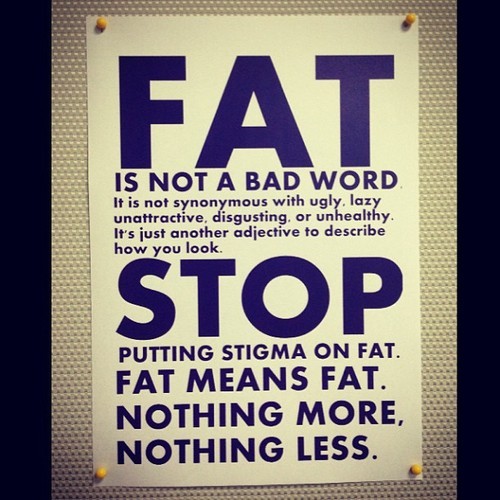
[Image description: On a white background in blue print, the graphic reads, “Fat is not a bad word. It is not synonymous with ugly, lazy, unattractive, disgusting, or unhealthy. It’s just another adjective to describe how you look. Stop putting stigma on fat. Fat means fat. Nothing more. Nothing less.” The sign is pinned, with a yellow push pin at each corner, to a grey textured background.]
Have you ever read something interesting, uplifting, or out of the ordinary on your Facebook feed? Have you then read the comments and been reduced to shaking your head, narrowing your eyes at the screen, completely confused?
I once found a picture the Cosmopolitan Magazine page had posted to their Facebook timeline. It featured supermodel Robyn Lawley, wearing a bikini during a photography shoot. The caption read as follows:
“Plus-size supermodel Robyn Lawley is BEYOND in
this sexy swim shoot for Cosmo Australia.”
To me, the post was completely normal. The picture of the woman was also completely normal, considering that she is a supermodel. So, what was the root of my confusion?
Ah, yes. You HAVE been paying attention. It was the comments.
Liran states:
Dear Cosmo,
Kindly take your ideas of “plus size” and shove them up your ass sideways.
Sincerely,
Every man on the planet who has had to reassure his perfectly healthy and proportioned woman she’s not fat
because assholes like you perpetuate this idea in her head that she’s “plus size.”
Megan remarks:
It makes me sad for our young girls that this beautiful, healthy-looking woman is considered “plus” sized.
It’s no wonder there are so many school aged girls with eating disorders…
Countless others rushed to the defense of Robyn, the woman who was being so “wrongfully labeled” as “plus sized.”
———
This is where I began generating a list:
1. Assumption that, if a woman is labeled as “plus sized,” it’s derogatory and an extreme insult.
BEING PLUS SIZED IS NOT A BAD THING. However, it’s understandable why we think this way. The media we consume conditions us. I’m not saying media is assigned all blame. The issue lies in the fact that we assume a few things:
a) Women like to be considered thin or healthy. Thin and healthy are often interchangeable. A slim woman is more likely to be considered healthy than a heavier woman.
b) Women look down upon being very thin. Being a very thin model is nasty and “distorts society’s idea of beauty.”
c) Being called fat is HORRIBLE. It is AWFUL. As a woman, you have literally lived your whole life in crippling fear of becoming fat. You love the gym. You strive to eat really healthy meals. You adore fitspo. You
are “curvy”, “big boned”, “big bootied” and “voluptuous”. You are definitely NOT FAT.
2. Fat is a bad word.
It becomes a little clearer. Plus-sized is fat, and ultimately, being fat means you’re unhealthy and/or undesirable. When this line of thought is presented to a person enough times, the words “plus-sized” automatically trigger the ungrounded assumption that the speaker has
just called the individual in question unhealthy and/or undesirable.
Have you ever heard a woman remark “I’m so fat”, only to be met with a chorus of “of course you aren’ts”? It’s almost automatic to console someone for being told, or for thinking, they are fat. On the other hand, it’s common to hear “you’ve gotten so thin!” used as a compliment. It’s only logical, because if fatness is the enemy, thinness is the ally.
We fear a word so much that its utterance can shatter self-esteem. Being called fat is traumatizing, and when used by others, is said to inflict emotional damage. A three-letter word carries so much cultural significance that we spend our entire lives running from it.
The saying “you aren’t fat, you’re curvy” doesn’t help that much because it can still carry the idea that fat is a separate entity. Using “curvy” and “bigger” instead perpetuates the idea that fat is bad. It’s a band-aid solution for a deep-set insecurity (and it certainly doesn’t do me any favours, personally).
3. Beauty doesn’t encompass fatness.
Beauty isn’t a “you’re not ugly, it’s society who’s ugly” situation. It’s a mindset. Sure, I can blame the media for feeding us ideas of beauty, but we are also obsessed with it. The obsession runs so deep that we forget that a person is composed of other things, too.Physical appearances are fixation points.
For a lot of fat women, the only compliment we can hope to receive is on our “pretty faces” or ample breasts and behinds. This reduces us to a few socially acceptable qualities. The rest of the self is almost disregarded.
Often what you hear is “she isn’t skinny, but she’s really smart.” It’s like people truly believe a woman can only be the magazine definition of physically beautiful or intelligent. There is this strange idea where a woman can’t be both (it’s a really stupid idea).
4. You can’t be fat and wear certain clothes.
I live in tight jeans and leggings. Many of my shirts hug every inch of my torso. I wear what I want when I want. It’s my body and I can dress is however I damn well please. If you try and tell me certain clothes weren’t designed for my body shape I WILL disregard your existence
and walk away from you.
NEXT.
5. Fit is the new skinny.
Women should be toned. Boniness is no longer in style—rippling muscles are. You should go on runs and consume three pounds of raw veggies with every meal. You should work out every day. Healthy is good, and everything else is bad.
This is replacing one standard with another. It simply shifts the point on the spectrum that we consider acceptable. It doesn’t fix anything. Looking down on someone who doesn’t follow your idea of a “fit lifestyle” is in no way better.
Lifestyles are choices, and one lifestyle is NOT better than another. People should exercise only if they want to. Additionally, being a regularly active person does not make you superior to anyone else. You have not magically become an authority on all things health related as a result. Do you. Let others handle their own business.
(This point is very general because I could write an entire essay on it alone. Maybe I will. Stay tuned, folks.)
———
We reinforce strange expectations by validating certain bodies but not others. You are expected to have an hourglass figure, complete with an even bust-to-hip ratio. Your legs should be long and thin, your arms the same. You should be tall, but not taller than all of the boys. Your weight should be optimal. It’s as if nature has made a mistake we have to correct.
The biggest lie you have ever been told is that physically larger women are incapable of being comfortable with their bodies. If I know any happy people, they are those who are at peace with all aspects of themselves—not just the physical. Comfort is found within, a blissful state of being; it’s also easier than hating yourself for what you’re not.
I am not ashamed to reclaim the word fat, and boldly state that I fit the definition of a fat woman. I just as boldly state that there is no shame in my plus-sizedness. If you have a problem with how comfortable I am in my own skin, I am indifferent.
We shouldn’t be offended by a word as simple as fat. Words are not defining points. When you take the sting away, all you’re left with is three letters that hold little actual meaning. A positive mindset about bodies is where the radical shift begins.
Good fattitude, good life.
[Headline image: The photograph shows six large women of different races side by side. Each is wearing fabric around their bodies that is striped with blue, orange, pink, and yellow.]
———
Nadia Nadeem is an independent writer. She attends McMaster University, where she studies Psychology, Neuroscience & Behaviour. She is an advocate for body positivity and self-love.
When asked why she submitted this piece to The Body is Not an Apology, Nadia wrote: “I feel there is a lot of shame associated with body types that differ from the norm. With reference to fatness, the language used to describe larger bodies is typically negative. I wrote this piece to examine the word ‘fat,’ and to come to the realization that it is just a word. It does not have the power to define one’s character.”
Source:- http://thebodyisnotanapology.com/magazine/an-essay-on-fattitude/